Flexible Intermediate Bulk Containers, better known as FIBC bags, jumbo bags, or big bags, are one of the quiet success stories of modern industrial packaging. Today they move everything from cement and chemicals to grains and pharmaceutical powders across the globe, carrying loads of up to two tonnes in a container that folds flat when empty and weighs only a few kilograms. But the FIBC bag we know today is the result of nearly seven decades of material science, engineering, and regulatory evolution. Here’s how bulk packaging went from sacks and drums to the sophisticated, certified FIBC bags that now shape global trade.
Bulk Packaging Before FIBC
Before the 1950s, bulk materials were mostly moved in jute sacks, wooden crates, and steel drums. Each had serious drawbacks. Jute sacks absorbed moisture and tore easily under heavy loads. Wooden crates were bulky, expensive to produce, and difficult to store or return. Steel drums were durable but heavy, costly to transport, and impractical for many dry, free-flowing materials like grains, minerals, and powders. Industries needed something lighter, cheaper, reusable, and easier to handle with the mechanical lifting equipment that was becoming common in warehouses and ports.
The Arrival of Woven Polypropylene
The real turning point came with the commercial development of polypropylene (PP) in the 1950s. PP was strong, lightweight, resistant to moisture and chemicals, and could be extruded into tapes and woven into fabric. By the 1960s, manufacturers were producing woven PP sacks as a replacement for jute, and it quickly became clear that the same fabric, scaled up and reinforced, could hold far more than a standard sack.
This was the technical foundation the FIBC industry was built on: durable woven polypropylene fabric, cut and stitched into large containers with lifting loops, capable of carrying loads that would previously have required a drum or a pallet of smaller sacks.
The 1970s and 80s: FIBC Bags Take Shape
Through the 1970s, as chemical, cement, and agricultural industries scaled up production and international trade expanded, demand grew for a bulk container that could be filled, moved, stacked, shipped, and emptied without special equipment beyond a forklift or crane. This is the decade the FIBC bag as a distinct product category really emerged, first in Europe and the United States, and soon after in Asia as manufacturing capability spread.
India entered this story in this same window. Mittal Technopack’s own roots go back to 1985, when the company was established in Dhanbad, Jharkhand, as Mittal Polypack Private Limited, right as the woven sack and FIBC industry was taking hold as a serious manufacturing category in the country. As the potential of FIBC bags became clearer, Mittal Technopack Private Limited was set up in Kolkata to focus specifically on FIBC production, eventually building an annual capacity of 12,000 metric tonnes of FIBC bags alongside 7,500 metric tonnes of PP woven fabric.
The 1990s and 2000s: Standardization and Specialization
As FIBC bags moved from a niche industrial product to a global logistics staple, two things happened at once: buyers began demanding proof of quality and safety, and manufacturers began designing bags for increasingly specific jobs.
Standardization came through international bodies. ISO standards and UN certifications for the packaging of hazardous and dangerous goods gave buyers a way to verify that a bag met defined safe working loads, seam strength, and handling requirements before it ever left the factory. For manufacturers, meeting these standards became the price of entry into export markets.
Specialization came from the sheer diversity of materials being packed. A single “FIBC bag” design couldn’t serve a cement plant, a fine chemical producer, and a grain exporter equally well, so the product family branched out:
- U-panel and tubular bags for general-purpose bulk handling
- Baffle bags, with internal panels that hold the bag’s shape and improve space utilization in containers and warehouses
- Circular and loop bags, designed around specific lifting and stacking needs
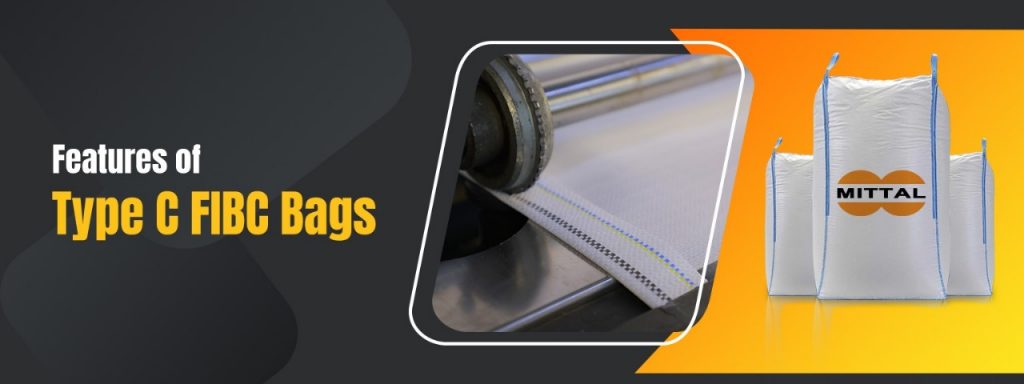
- Conductive or Type-C bags, built to safely dissipate static electricity when packing fine powders or flammable materials
- Liner bags, using PE or PP liners inside the FIBC to protect moisture-sensitive or high-purity contents
This was also the period when export-oriented FIBC manufacturers, including Mittal Technopack, built out the certifications and infrastructure to serve international markets, culminating in recognition from the Government of India as an AEO-status, 2-star export house for its export contribution.
2010s to Today: Food Safety and Global Compliance
As FIBC bags began carrying food ingredients, pharmaceutical raw materials, and other sensitive contents, the industry’s compliance bar rose again. Certifications like BRCGS (British Retail Consortium Global Standards) became central to proving that a manufacturing facility could produce bags safe for food-grade use, alongside Halal, Kosher, and other market-specific certifications.
This is the era that produced dedicated food-grade manufacturing units within FIBC companies. Mittal Technopack set up its own state-of-the-art food-grade facility, MTPL Unit II, in 2020, accredited by SGS (UK) with an AA grading — the highest tier under the BRCGS framework. In 2021, the company added another manufacturing unit, SDRP Global Private Limited in Dhanbad, to keep pace with rising customer demand, alongside the SDRP Charitable Trust as part of its community commitments.
Where FIBC Design Is Headed Next
The evolution hasn’t stopped. Current-generation FIBC bags are engineered around a few key priorities:
- Material efficiency: producing certified bags with the lowest possible fabric weight (GSM) while still meeting or exceeding safe working load ratings, cutting material use and shipping weight without cutting strength.
- Application-specific engineering: bags built for particular risks, like conductive Type-C bags for static-sensitive powders, or UN-rated bags for regulated hazardous goods.
- Traceability and quality assurance: tighter in-line quality control, batch tracking, and testing regimes that let buyers verify exactly what they’re receiving.
- Sustainability: a growing industry conversation around recyclability, reduced material use, and the long-term lifecycle of PP-based packaging, as buyers across sectors face their own sustainability commitments.
A Global Industry Built on Incremental Engineering
What started as a simple woven polypropylene alternative to the jute sack is now a precisely engineered, internationally certified product family serving cement, chemicals, agriculture, food, pharmaceuticals, and dozens of other industries across more than 40 countries. Every stage of that evolution, from the first woven PP fabric to today’s food-grade, static-dissipative, UN-rated bags, was driven by the same basic question the industry started with: how do you move more material, more safely, more efficiently, in a container that costs less to make and less to ship than what came before?
That question is still shaping the next generation of FIBC bags, and manufacturers who have grown up alongside the industry, adding capacity, certifications, and specialized product lines at each stage, remain best placed to keep answering it.