Choosing the right packaging solution is important for businesses that handle bulk materials warehouse or supply. The right bag can help reduce packaging costs, improve product safety and efficiency, protect products during transportation, and make storage easier. Two commonly used polypropylene-based packaging solutions are FIBC bags and PP woven bags.
But which one is better: FIBC Jumbo Bags or PP Woven Bags?
The answer depends mainly on the quantity of material being packed, handling requirements, storage conditions, transportation method, and industry application. In this guide, we compare FIBC and PP woven bags to help businesses choose the right bulk packaging solution.
What Is an FIBC Bag?
FIBC, or Flexible Intermediate Bulk Container, is a large, flexible bag designed for storing and transporting bulk materials. FIBC bags are commonly known as Jumbo Bags, Bulk Bags, or Super Sacks.
They are manufactured using woven polypropylene fabric and are available in different sizes, designs, lifting arrangements, discharge options, and customized specifications.
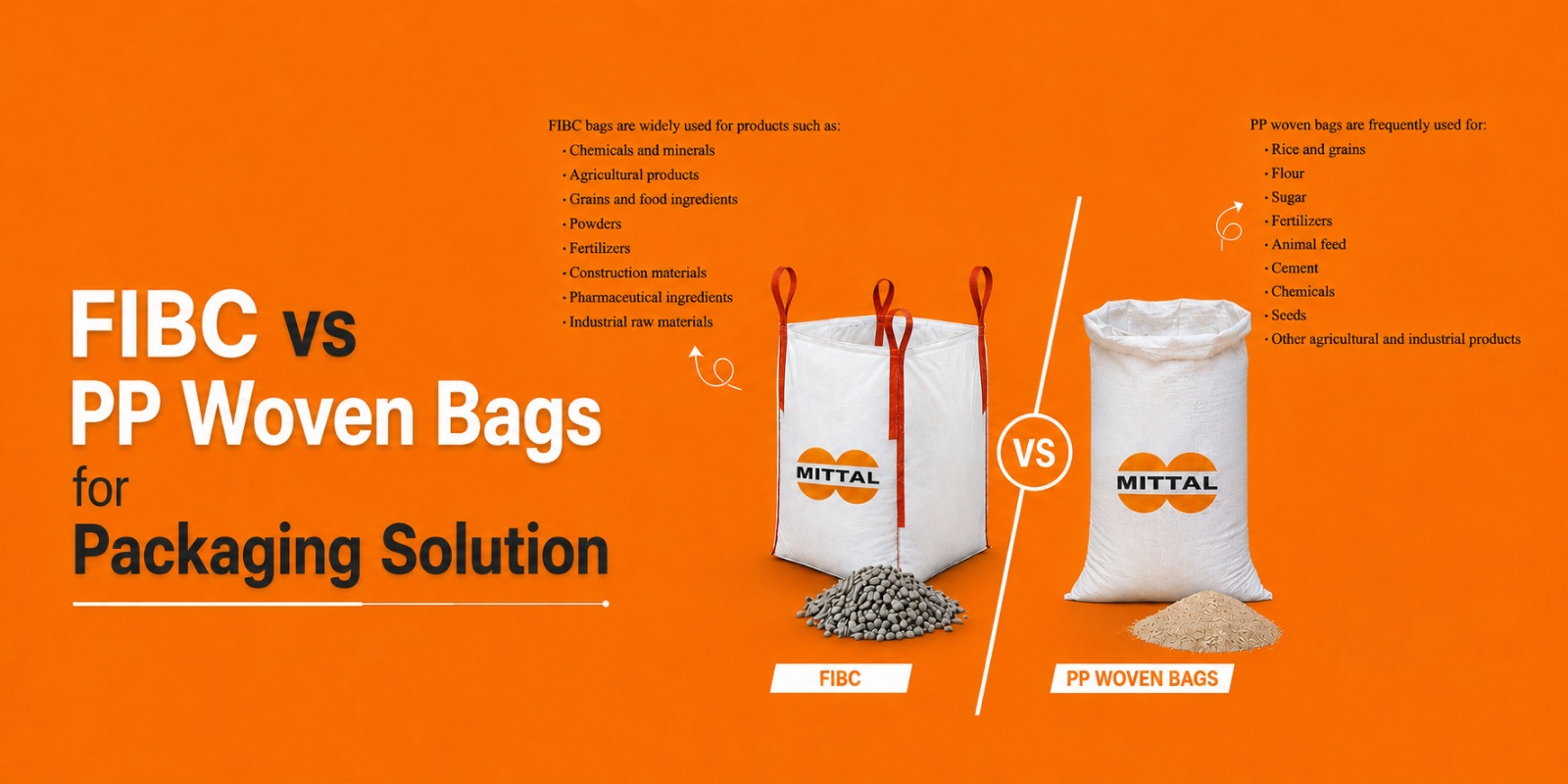
FIBC bags are widely used for products such as:
- Chemicals and minerals
- Agricultural products
- Grains and food ingredients
- Powders
- Fertilizers
- Construction materials
- Pharmaceutical ingredients
- Industrial raw materials
Depending on the application, FIBC bags can be manufactured with different configurations, including U+2 Panel Bags, Tubular Bags, Q Bags, One Loop Bags, Two Loop Bags, Tunnel Loop Bags, and Sling Bags.
What Are PP Woven Bags?
PP woven bags are packaging bags made from woven polypropylene tapes. They are generally smaller than FIBC bags and are commonly used for packaging products in smaller quantities.
PP woven bags are frequently used for:
- Rice and grains
- Flour
- Sugar
- Fertilizers
- Animal feed
- Cement
- Chemicals
- Seeds
- Other agricultural and industrial products
Their relatively simple construction makes them a practical option for products that need to be packed, stored, and transported in smaller quantities.
FIBC vs PP Woven Bags: Key Difference
The biggest difference between FIBC and PP woven bags is their capacity and handling method.
FIBC bags are specifically designed for bulk handling and can carry significantly larger quantities of material in a single container. PP woven bags are generally better suited for smaller-volume packaging.
For example, if a business needs to transport bulk powder or raw material using forklifts, cranes, or other mechanical handling equipment, FIBC bags can offer a more efficient solution than handling numerous smaller bags.
FIBC vs PP Woven Bags Comparison
| Factor | FIBC Bags | PP Woven Bags |
| Typical application | Bulk material handling | Small and medium quantity packaging |
| Capacity | High-capacity packaging | Lower capacity |
| Handling | Forklift, crane, pallet or lifting systems | Usually manual or pallet handling |
| Material | Woven polypropylene | Woven polypropylene |
| Customization | Extensive customization options | Available but generally simpler |
| Storage efficiency | Excellent for bulk materials | Suitable for stacked smaller units |
| Bulk transportation | Highly suitable | Suitable for smaller quantities |
| Filling and discharge | Can be designed with specialized options | Generally simpler |
| Industrial applications | Extensive | Extensive |
| Packaging efficiency | High for bulk materials | Better for smaller quantities |
Which Is More Cost-Effective: FIBC or PP Woven Bags?
Cost should not be evaluated only by the price of an individual bag. Businesses should also consider material handling, labour, transportation, storage, filling, unloading, and overall packaging efficiency.
For bulk materials, FIBC bags can reduce the number of individual packaging units required. Instead of handling many smaller PP woven bags, a company can consolidate material into larger FIBC bags.
This can potentially reduce handling time and improve transportation efficiency.
On the other hand, PP woven bags can be more practical when products need to be distributed in smaller quantities. For example, if customers purchase a product in 25 kg or 50 kg quantities, smaller PP woven bags may be more suitable.
Therefore, FIBC is generally more efficient for bulk handling, while PP woven bags can be more practical for smaller-unit packaging.
Which Bag Is Better for Transportation?
FIBC bags are particularly useful when large quantities of material need to be transported between manufacturing plants, warehouses, ports, and distribution centres.
Their lifting loops allow the bags to be handled using suitable lifting equipment. This can simplify loading and unloading operations and reduce the need to manually handle multiple smaller bags.
PP woven bags can also be transported efficiently, especially when they are palletized. However, transporting the same total quantity may require significantly more individual bags.
For businesses focused on bulk logistics, FIBC bags can provide a more efficient transportation solution.
Which Bag Is Better for Warehouse Storage?
Warehouse storage requirements depend on the material and packaging configuration.
FIBC bags can be designed in different dimensions and shapes to suit available storage space. Form-stabilized designs such as Q Bags or Baffle Bags can maintain a more stable shape after filling, which can be useful for efficient warehouse utilization.
PP woven bags are also easy to stack, particularly on pallets, but businesses handling large quantities may need to manage a much higher number of individual units.
For large-volume raw materials, FIBC bags can simplify inventory handling and warehouse operations.
FIBC Bags Offer More Customization Options
One of the major advantages of FIBC packaging is the ability to customize the bag according to the application.
Businesses can specify requirements related to:
- Bag dimensions: The size can be selected according to product volume, storage space, and transportation requirements.
- Lifting configuration: Different loop and lifting designs can be selected according to handling equipment.
- Top and bottom construction: Filling and discharge arrangements can be customized based on the product and handling process.
- Liner: Depending on the material, an inner liner may be required to provide additional product protection.
- Fabric and construction: The FIBC design can be selected according to the required load capacity and application.
This makes FIBC bags suitable for a wide range of industrial applications.
When Should You Choose FIBC Bags?
FIBC bags are generally a good choice when your business needs to:
- Package large quantities of material
- Reduce the number of individual packaging units
- Improve bulk material handling
- Use forklifts, cranes, or suitable lifting equipment
- Optimize warehouse and transportation operations
- Transport powders, granules, minerals, chemicals, grains, or other bulk materials
- Customize packaging according to a specific industrial application
Industries such as chemicals, agriculture, food processing, pharmaceuticals, minerals, construction, and manufacturing can benefit from properly specified FIBC solutions.
When Should You Choose PP Woven Bags?
PP woven bags may be the better option when:
- Products are sold in smaller quantities
- Manual handling is common
- Customers require individual bags
- The product is distributed through retail or smaller distribution channels
- Palletized packaging is sufficient
- Large bulk containers are unnecessary
For example, a company selling agricultural products in smaller quantities may find PP woven bags more convenient than FIBC bags.
FIBC vs PP Woven Bags: Which One Should You Choose?
There is no single packaging solution that is best for every business.
If your primary requirement is large-volume storage and transportation, FIBC Jumbo Bags are generally the more suitable choice. They can accommodate bulk quantities and are designed for efficient filling, lifting, transportation, and discharge.
If your products need to be supplied in smaller quantities, PP woven bags may be more appropriate and economical.
The right decision should therefore be based on product type, required capacity, handling system, transportation method, storage conditions, safety requirements, and customer requirements.
Why Choose FIBC Jumbo Bags from Mittal Technopack?
Mittal Technopack Pvt. Ltd. is an experienced FIBC Jumbo Bag manufacturer and supplier in India, serving customers in domestic and international markets.
The company offers a wide range of FIBC solutions, including U+2 Bags, Tubular Bags, 4 Panel + Baffle/Q Bags, One Loop Bags, Two Loop Bags, Tunnel Loop Bags, and Sling Bags.
Its FIBC solutions are designed for different bulk packaging and material-handling requirements, with customization available according to application needs.
Mittal Technopack has an international presence across markets in Europe, the UK, USA, Australia, Canada, Israel, and Africa and has experience serving diverse bulk packaging requirements.
The company also states that its facility has certifications and recognitions including BRCGS AA++, ISO 9001, ISO 22000, HALAL, KOSHER, and Two Star Export House status.
Frequently Asked Questions
- Is FIBC the same as a PP woven bag?
No. FIBC bags are also commonly manufactured from woven polypropylene, but they are specifically designed as large-capacity bulk containers. PP woven bags are generally smaller packaging units used for products packed in lower quantities.
- Are FIBC bags stronger than PP woven bags?
FIBC bags are engineered for bulk material handling and are designed according to specified load and safety requirements. However, the actual strength depends on the fabric, construction, stitching, design, and specifications of the individual bag.
- Which is better for bulk materials, FIBC or PP woven bags?
For large quantities of bulk material, FIBC bags are generally more suitable because they can consolidate material into larger units and support efficient mechanical handling.
- Can FIBC bags be customized?
Yes. FIBC bags can be customized in terms of dimensions, construction, lifting loops, filling and discharge options, liners, and other application-specific requirements.
- Are FIBC bags suitable for food products?
FIBC bags can be manufactured for food-related applications when the required material, construction, hygiene, and applicable regulatory requirements are properly specified. Businesses should discuss their exact food-contact requirements with the manufacturer before ordering.
Final Verdict
FIBC and PP woven bags are not direct substitutes in every application. Both are useful polypropylene packaging solutions, but they serve different packaging requirements.
For large-volume industrial storage, bulk transportation, mechanical handling, and customized packaging, FIBC Jumbo Bags are often the more efficient solution.
For smaller quantities, individual product distribution, and simpler packaging requirements, PP woven bags can be a practical choice.
The best packaging solution is the one that matches your product, quantity, handling process, storage requirements, and transportation needs.
If you are looking for a reliable FIBC Jumbo Bag manufacturer in India, Mittal Technopack can help you select a suitable bulk packaging solution based on your specific application and requirements.