



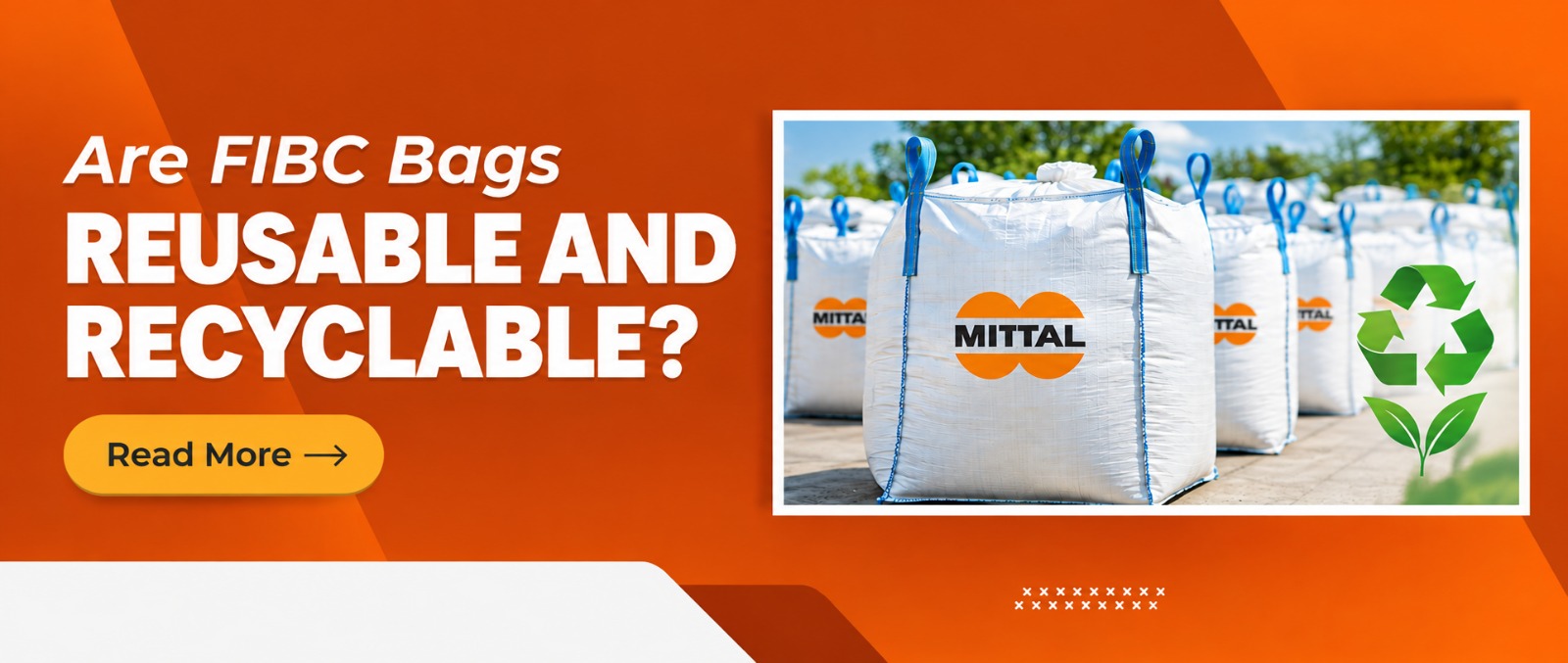
FIBCs, commonly called FIBC bags, bulk bags or jumbo bags, are widely used for storing and transporting large quantities of dry and free-flowing materials. From agriculture and food products to chemicals, minerals, construction materials and industrial products, these bags have become an important part of modern bulk packaging.
But as businesses pay more attention to packaging waste and sustainability, one common question comes up:
Are FIBC bags reusable and recyclable?
The answer is yes, many FIBC bags can be reused and recycled, but the exact approach depends on the type of bag, its construction, previous contents, condition and intended application. Mittal Technopack manufactures FIBC bags with different specifications and designs to meet the requirements of various industries.
What Makes FIBC Bags Reusable?
FIBC bags are generally manufactured using woven polypropylene, a strong and lightweight material. The fabric is designed to handle substantial loads while remaining flexible enough for convenient storage and transportation.
However, not every FIBC should automatically be reused.
The bag must first be suitable for multiple trips and should be inspected before another filling cycle.
An FIBC may be suitable for reuse when:
- It is specifically designed as a multi-trip FIBC.
- The fabric remains in good condition.
- Lifting loops are not damaged or excessively worn.
- Seams and stitching remain secure.
- The bag has not been exposed to unsuitable chemicals or environmental conditions.
- The previous contents do not create contamination concerns.
- The bag’s Safe Working Load (SWL) continues to be appropriate for the intended application.
Mittal Technopack also highlights the importance of inspecting FIBC bags before reuse and using multi-trip bags for applications where repeated use is required.
How Many Times Can an FIBC Bag Be Reused?
There is no universal number of reuse cycles for every FIBC bag.
The lifespan depends on several factors:
| Factor | Why It Matters |
| Bag construction | Stronger construction can support demanding applications |
| Safe Working Load | The bag must remain suitable for the required load |
| Handling method | Rough handling can damage fabric and loops |
| Product being carried | Some materials may affect the bag’s suitability for reuse |
| Storage conditions | UV exposure, moisture and improper storage can reduce service life |
| Cleaning requirements | Previous contents may affect whether reuse is appropriate |
| Bag design | Single-trip and multi-trip bags have different intended uses |
Therefore, businesses should follow the manufacturer’s specifications instead of assuming that every jumbo bag can be reused indefinitely.
Reuse Can Reduce Packaging Waste
One of the biggest advantages of a reusable FIBC is that the same bag can potentially serve more than one packaging cycle.
For businesses handling large quantities of materials, this can mean:
- Fewer bags required over time
- Reduced packaging waste
- Better utilization of packaging materials
- Lower storage requirements for empty packaging
- More efficient bulk handling
- Potential reduction in overall packaging costs
FIBC bags can also be folded when empty, which makes them convenient to store and transport between uses. Their lightweight construction can also help reduce the space and handling requirements associated with bulk packaging.
Are FIBC Bags Recyclable?
Yes. FIBC bags made from recyclable polypropylene can be recovered and processed at the end of their useful life.
Instead of sending an old bag directly to landfill, suitable material can enter a recycling stream where the polypropylene is processed for further applications.
Mittal Technopack specifically identifies its FIBC bags as recyclable and notes that bags can be recycled for different applications.
The recycling process generally involves steps such as:
- Collection – Used FIBC bags are collected after their service life.
- Inspection and segregation – Bags are separated according to material, condition and previous use.
- Cleaning – Where required and technically feasible, residual material is removed.
- Processing – Suitable polypropylene material is processed for recycling.
- Reintroduction – Recovered material can be used in appropriate plastic products or applications.
The exact recycling route depends on the material composition and condition of the bag.
Reuse vs Recycling: What Is the Difference?
These two terms are often used together, but they mean different things.
Reuse
The same FIBC bag remains intact and is used again for an appropriate application after inspection and, where required, cleaning.
Recycling
The material of the old bag is recovered and processed to make another product or material.
A simple way to understand the difference is:
Use → Inspect → Reuse → End of service life → Recycle
This approach can help businesses get more value from packaging materials while reducing unnecessary waste.
What Happens When an FIBC Bag Reaches the End of Its Life?
An FIBC bag should not be considered useless simply because it is no longer suitable for its original application.
Depending on its material and condition, it may enter a recycling or recovery process.
Mittal Technopack’s information on recyclable FIBC solutions reflects this approach, where polypropylene packaging can contribute to a more circular material cycle.
For example, the end-of-life process may look like:
- Used FIBC
- Condition assessment
- Reuse where appropriate
- Segregation of damaged bags
- Recycling of suitable polypropylene
- Conversion into other plastic applications
This helps reduce the amount of packaging material going to waste.
Are All FIBC Bags Suitable for Reuse?
No.
This is an important point for companies purchasing bulk bags.
An FIBC designed for a single trip should not automatically be treated as a reusable bag. Similarly, a bag that has developed damage, contamination or excessive wear should not be reused simply because it still looks usable.
Before reuse, businesses should check:
- Fabric condition
- Stitching
- Lifting loops
- Bottom discharge area
- Top construction
- Liner condition, if present
- Signs of abrasion
- Chemical exposure
- Previous contents
- Safe Working Load requirements
For demanding applications, the manufacturer’s specifications should always take priority.
Why Polypropylene Is Important for FIBC Recycling
Most conventional FIBC bags use polypropylene because it provides a useful combination of:
- High strength
- Low weight
- Flexibility
- Durability
- Resistance to moisture
- Suitability for woven fabric construction
- Recyclability
The woven structure allows manufacturers to produce strong bags without making them excessively heavy.
This balance between strength and material efficiency is one reason FIBC packaging is used across industries such as agriculture, chemicals, construction, mining, food and logistics. Mittal Technopack’s product range includes standard, circular, baffle, loop, conductive, UN and other specialized FIBC designs.
How FIBC Bags Support More Sustainable Bulk Packaging
Sustainability is not only about whether a product can be recycled. The entire packaging lifecycle matters.
FIBC bags can contribute to more efficient packaging systems because they combine high carrying capacity with relatively low packaging weight.
Some potential advantages include:
1. High Capacity
FIBC bags can carry large quantities of dry and flowable materials. The company’s product information lists capacities commonly ranging from 500 kg to 2,000 kg, depending on bag design and specification.
2. Reusable Options
Multi-trip FIBCs can be used repeatedly when the bag remains safe and suitable for the application.
3. Recyclable Material
Polypropylene FIBCs can be recycled through suitable recovery systems.
4. Space Efficiency
Empty FIBC bags can be folded, requiring considerably less storage space than rigid bulk containers.
5. Efficient Transportation
Their lightweight construction can help businesses move large quantities of material without adding unnecessary packaging weight.
Why Choose Mittal Technopack for FIBC Bags?
Mittal Technopack has been involved in the woven sack and FIBC industry since 1985, with its roots in Dhanbad and its FIBC manufacturing operations established in Kolkata. The company currently reports an annual FIBC capacity of 12,000 MTS and serves customers across more than 40 countries.
Its FIBC portfolio includes:
- U-Panel FIBC Bags
- Circular FIBC Bags
- Baffle Bags
- One Loop Bags
- Two Loop Bags
- Full Loop Bags
- Conductive / Type C Bags
- UN Bags
- Sling Bags
- Special-purpose FIBC Bags
- Container Liners
The company also operates a food-grade manufacturing facility accredited with BRCGS AA grading.
For businesses looking for bulk packaging that combines strength, flexibility, reusability and recyclability, the right FIBC specification can make a practical difference to everyday operations.
Frequently Asked Questions
Are FIBC bags reusable?
Yes, certain FIBC bags are designed for multiple trips and can be reused after proper inspection. Reuse depends on the bag design, condition, previous contents and application.
Are FIBC bags recyclable?
Yes. Polypropylene FIBC bags can be recycled through suitable recycling systems after they have reached the end of their useful service life.
Can damaged FIBC bags be reused?
A damaged FIBC should not be reused simply because it can still hold material. Fabric damage, worn lifting loops, weakened seams or other defects can affect safe handling.
Are FIBC bags environmentally friendly?
FIBC bags can support more sustainable packaging practices because reusable designs can reduce packaging waste and polypropylene bags can be recycled. Their lightweight construction can also improve packaging and transportation efficiency.
What is the difference between a single-trip and multi-trip FIBC?
A single-trip FIBC is intended for one transportation or handling cycle, while a multi-trip FIBC is specifically designed for repeated use under appropriate conditions.
What industries use recyclable FIBC bags?
FIBC bags are used in agriculture, food processing, chemicals, pharmaceuticals, construction, mining, waste management, logistics and other industries handling dry bulk materials.
Final Thoughts
FIBC bags offer more than a convenient way to move bulk materials. When the correct design is selected and the bag is used according to its specifications, reusable FIBCs can reduce the need for new packaging, while recyclable FIBCs can help recover valuable polypropylene material at the end of their service life.
For businesses, the key is not simply choosing any jumbo bag. It is selecting an FIBC that matches the material, load, handling conditions and intended number of uses.
With its range of standard and specialized FIBC solutions, Mittal Technopack provides bulk packaging options for different industrial requirements while maintaining a focus on durability, quality and efficient packaging.
When sustainability, safe handling and bulk transportation all matter, the right FIBC can become an important part of a more efficient packaging system.


